About Hedgelaying
 Hedgelaying is a country skill found across most of the UK, and is thought to date back as far as Roman times.
Over a period of time, many different styles have evolved depending on location, the stock and the land, but all work to produce the same goals, some of these being
Retaining livestock: Various finished heights maybe seen depending on stock, a laid hedge is a living fence
Helping to rejuvenate an old hedgerow and maintain new : By laying a hedge it will encourage new shoots & new life into the hedge
To provide greater weather protection for crops and local wildlife: When laid a hedge becomes a safer passage for the smaller wildlife to travel along, and for larger stock to shelter against.
The theory behind Hedgelaying is easy; the practice is not, requiring skill and experience more indepth details & info can be found covering Regional Styles, Groups Contests & Training on The National Hedgelaying Society pages at www.hedgelaying.org.uk

Styles laid by Russell are Dorset, South Of England, Devon, and maybe a bit of North Somerset.
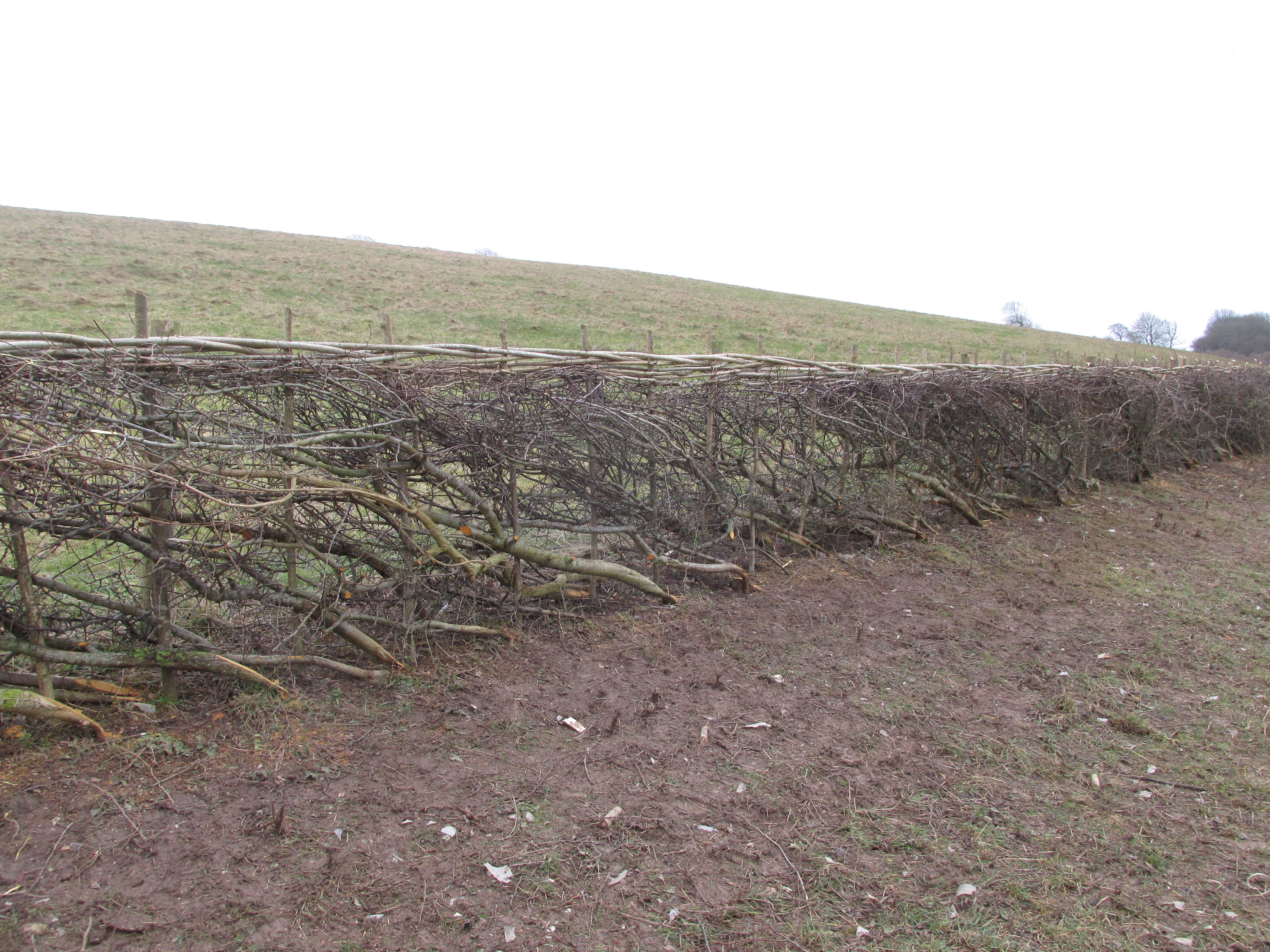
Dorset/Devon Hedges this is a low hedge flat to the ground or bank, a style suited to the control and shelter of sheep on downland. The pleachers are laid as low as possible and building a strong intertwined hedgerow, if required a hazel binders/bonds can be tucked under a pleacher on one side, and passed over the hedge about 30 degrees and tucked under the other side. These need to run in nicely with the hedge line and try to blend in and not just placed at right angles. This could also be done internally so as not to be seen (Dorset Style) , or held by crooks (Devon style).
South Of England style This hedge is cut and laid over to create a double brush. A single line of stakes 18″ apart in the centre of the hedge with the top bound. Both sides of the hedge are trimmed. For further information about the South of England style and group please look up www.sehls.weebly.com/
No matter what style String and Wire should NEVER be or needed to be used